Context
At DFINITY, I work on products where people manage accounts, identities, and balances, move funds, vote, and inspect network data. Each action depends on system states that are easy to miss in an interface: permissions, fees, transaction status, proposal consequences, and errors.
The work ranges from wallets and identity to governance and network dashboards. Before people move funds, vote, delegate, or act on metrics, the interface has to show what the system is doing and what their action will change.
My role
My work covers product framing, prototypes, design systems, launch assets, implementation support, and QA.
I work between product, engineering, marketing, and leadership. When a new capability is added, I help define how it works, how it appears in the interface, and how it is explained at launch.
Product threads
OISY Wallet
I lead product design for OISY Wallet, working on wallet flows for balances, recipients, fees, networks, confirmations, and transaction states.
ICP Dashboard
I led the full product redesign of the Internet Computer Dashboard. I restructured its navigation and organised network, subnet, token, and ecosystem data so people could understand how the network is structured and what the metrics mean.
NNS Governance
I have also worked on Network Nervous System product design, covering voting, delegation, proposals, rewards, and permissions. The interface needs to show the consequences before someone acts.
Ecosystem touchpoints
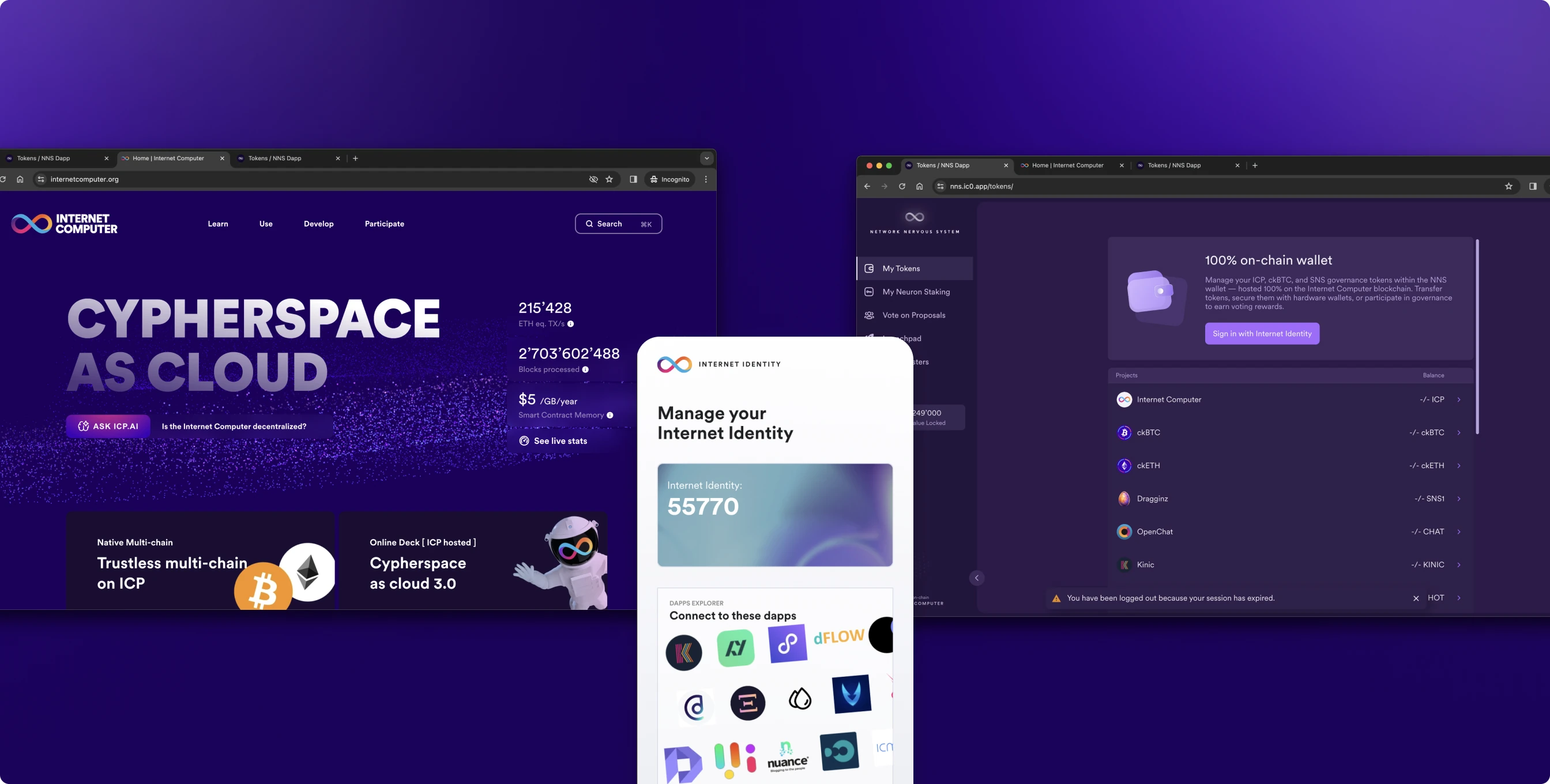
Other contributions include InternetComputer.org, Internet Identity, design systems, launch assets, and special projects across product, engineering, marketing, and community teams.
System states
Before working on interface details, I map account and identity states, permissions, balances, proposal consequences, network health, data relationships, loading, failure modes, and the information support teams need.
Designing consequential actions
Wallet transfers, governance decisions, and network metrics each need a different kind of explanation.
A wallet transfer should show the asset, recipient, network, fee, and result. A governance flow should state what a vote or delegation changes. Dashboard metrics need labels and relationships that show how the numbers fit into the network.
Work before the final screen
I use several artefacts to expose unresolved questions before engineering starts:
- product frames and decision notes
- state maps for flows and edge cases
- before and after navigation structures
- prototypes for critical wallet and governance actions
- reusable interface patterns for repeated system states
- launch assets and product language for new features
I joined DFINITY as a full-time employee in 2022 after previously contributing as a contractor.